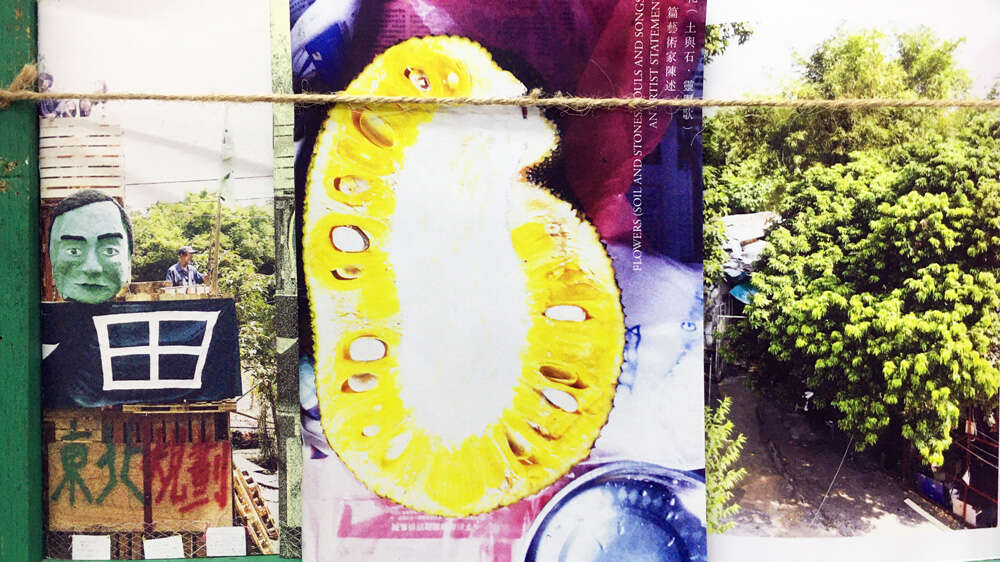
Zines. Photo by Michael Leung
The Guttormsgaard Archive
Wednesday 26 August at 10-16
Join us at the Guttormsgaard Archive for a zine writing workshop with Hong Kong artist and writer Michael Leung, Oslo-based artist and writer Ina Hagen and graphic designer and illustrator Tiril Haug Johne, followed by an introduction to the Archive by its director Ellef Prestsæter and viewing of Asian artifacts with Prof. Nachiket Chanchani (University of Michigan) and Sarah Chen Huang (ECOART, UiO).
The workshop forms part of a three-day program on artistic research, ecological humanities and Asia organized by Sarah Chen Huang. Bringing together international and local artists, scholars, and artist-researchers, the events take place at the Nordic Black Theatre, the Guttormsgaard Archive, and Oslo National Academy of the Arts.
About the writing workshop
The morning workshop invites participants to write with non-human species through multispecies narration and expand on past, current and speculative social movements. Michael Leung will introduce different actors such as Negro Matapacos in Chile, the Leopards of Aarey Forest in Mumbai, and a Chinese Bee colony on a rooftop in Hong Kong.
Ina Hagen will tell the stories of a Permian fossilized fern. Known as “the Tongue Fern”, it is commonly extracted as coal. Starting with a historical study of the fern, Ina further reflects on its materiality and the desire to reach for “contact” with prehistoric matter through language.
Tiril Haug Johne will bring in the inspiration of Lillebet Foss (1930–2017), a Norwegian artist who worked across many media and spoke several languages, including Bulgarian, French, Turkish, and Norwegian. Looking at her artworks, however, one might start to believe that she was able to talk with animals as well.
After the introduction, we will write outdoors and then share the stories, which will be made into a zine.
Michael Leung is an artist/designer and writer based in Hong Kong. His practice relates to mutual aid, publishing and the commons. His work is situated in everyday life, affected by convivial encounters, and inspired by different autonomous spaces and communities.
Ina Hagen is an artist and writer based in Oslo, Norway. Her artistic practice spans text and performance, video and digital media, collective making practices and pedagogical forms. Hagen aims to critically interrogate hegemonic narratives, with an interest in the artistic process as a form of civic participation.
Tiril Haug Johne is a graphic designer, illustrator and cultural worker from Oslo. She primarily works with artistic publishing and drawing, and is the director of the Lillebet Foss Museum at the Guttormsgaard Archive.
About the artifact viewing
The afternoon viewing starts with an introduction to the Norwegian artist Guttorm Guttormsgaard (1938–2019) and his collecting practices by Ellef Prestsæter, the director of the Guttormsgaard Archive, before we look closely at selected Asian artifacts from the collection. Prof. Nachiket Chanchani will discuss five small Indian bronze sculptures and Dr. Sarah Chen Huang will talk about East Asian woodblocks and printed books.
Ellef Prestsæter is an art historian and curator. He is the artistic director of the Guttormsgaard Archive and a founding member of the art and research group Institute for Computational Vandalism.
Nachiket Chanchani is Associate Professor of South Asian Art and Visual Culture at the University of Michigan. He has published widely on the art and architecture of South and Southeast Asia.
Sarah Chen Huang is a historian of art and science focusing on early modern China. She is a post-doctoral fellow in the ECOART project at the Department of Philosophy, Classics, History of Art and Ideas, University of Oslo.
Program
10:00 – 13:00 Multispecies creative writing workshop
13:00 – 14:00 Vegetarian lunch
14:00 – 16:00 Viewing of Asian artifacts
This event is organized by the research project Creative Agency and Environmental Humanities at Oslo Center for Environmental Humanities, co-organized by the Guttormsgaard Archive, in collaboration with the research project An Ecological History of Eurasian Art. Sincere thanks also extend to Wenkai Xu and Christine Kaiser.
Funded by the European Union (ERC, ECOART, 101124354). Views and opinions expressed are however those of the author(s) only and do not necessarily reflect those of the European Union or the European Research Council Executive Agency. Neither the European Union nor the granting authority can be held responsible for them.